EU AI Act đã có hiệu lực: Cửa hàng Shopify phải công bố gì về chatbot AI
Từ 2/8/2026, EU AI Act có hiệu lực. Cửa hàng Shopify dùng chatbot AI có nghĩa vụ công bố. Đây là yêu cầu, điều gì kích hoạt, cách tuân thủ không đổi stack.
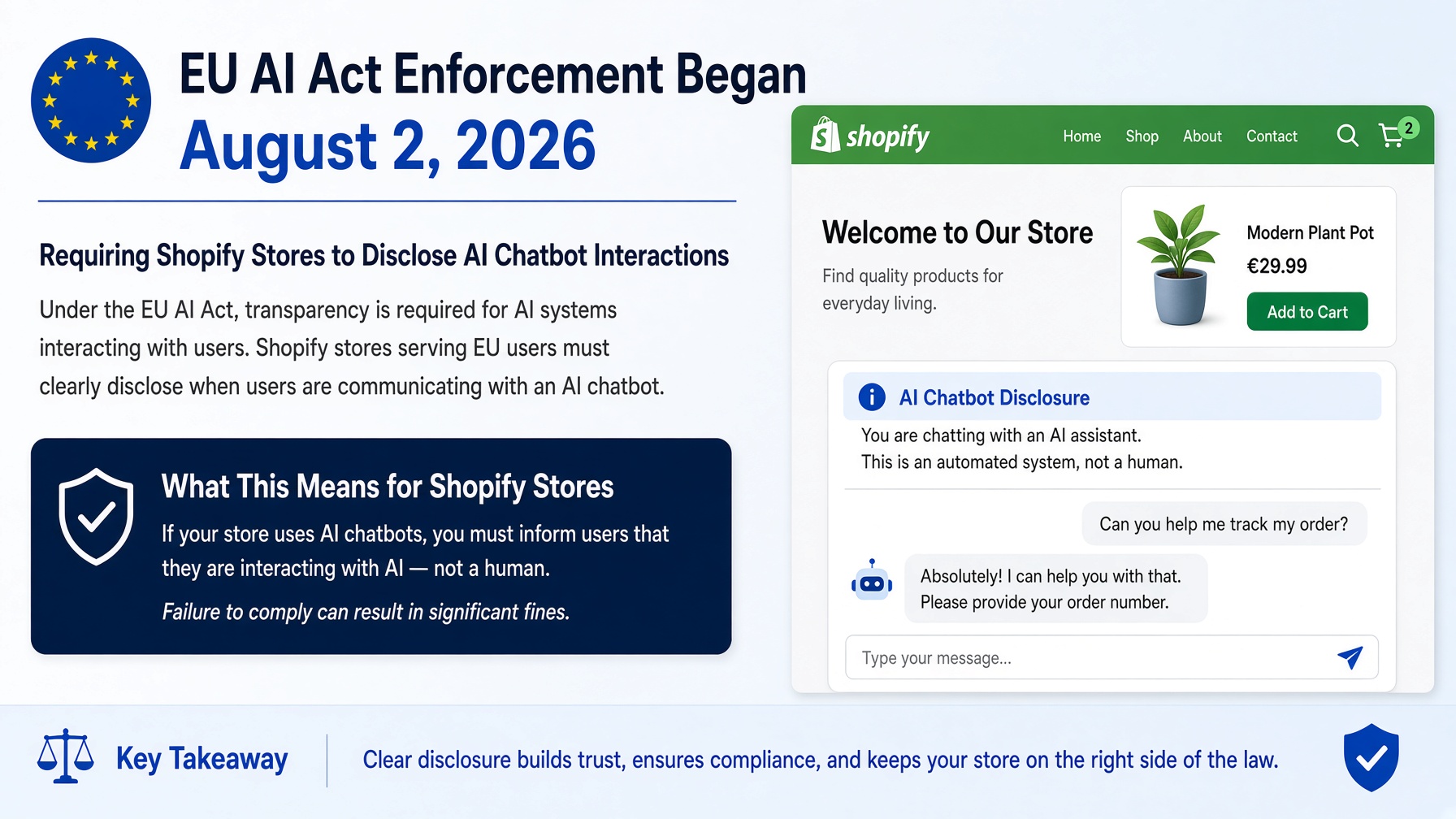
As of August 2, 2026, the European Union's AI Act entered its enforcement phase — and if your Shopify store uses any AI chatbot, shopping assistant, or automated support tool, you now have disclosure obligations you didn't have a month ago. This isn't a future regulation to watch. It's live, and it applies to stores outside the EU too, as long as they serve EU shoppers.
This article breaks down what the EU AI Act requires of ecommerce stores in practice, which interactions trigger disclosure, what counts as "transparent" disclosure, and how to make your AI chatbot compliant without ripping out your existing stack.
What the EU AI Act actually requires (for ecommerce)
The EU AI Act is a broad regulation covering AI systems across industries. The part that matters for Shopify merchants is the transparency obligation for AI systems that interact with humans — found in Article 52.
The core requirement is simple to state: when a person is interacting with an AI system rather than a human, they must be told.
For ecommerce stores, this means:
- If a chatbot answers customer questions, the customer must know it's an AI, not a human agent.
- If AI generates content (product descriptions, review summaries, personalized recommendations), that fact must be disclosable.
- If AI is used to detect shopper emotion or behavior (some advanced store analytics do this), it triggers additional rules.
The August 2 enforcement date specifically covers transparency and minimum AI literacy obligations. Other parts of the Act (high-risk system obligations, GPAI model rules) phase in over the following years. So the thing you must do *now* is transparency.
"I'm a US store, does this apply to me?"
Yes, in most cases.
The EU AI Act has extraterritorial scope — the same logic as GDPR. If your store is accessible to EU shoppers and the AI system's output affects people in the EU, the regulation applies regardless of where your company is incorporated.
In practice, this covers:
- Any Shopify store shipping to EU countries
- Any store with EU website visitors (which is nearly every store)
- Any store where the AI chatbot processes EU shopper data
If you're a North American DTC brand and you've ever shipped to Germany, France, or the Netherlands, this applies to you.
Which interactions trigger disclosure?
Not every use of AI triggers the transparency rule. The ones that do, for a typical Shopify store:
- Chatbot answers shopper questions about products, stock, shipping — Yes, triggers disclosure
- AI shopping assistant recommends products or helps with checkout — Yes
- AI-generated product descriptions shown to shoppers — Yes (if not obvious)
- AI-summarized customer reviews — Yes
- AI used internally (inventory forecasting, fraud detection) — No (not shopper-facing)
- AI used to personalize email subject lines — Gray area (disclose in privacy policy)
The common thread: if a shopper interacts with, or sees content from, an AI system, disclosure is required.
What "transparent disclosure" actually means
The regulation doesn't prescribe a specific format, but EU guidance and emerging industry consensus point to these standards:
- At the start of the interaction. The shopper must be told they're interacting with AI *before* the interaction unfolds, not buried in a terms-of-service page.
- Clear and plain language. "I'm an AI assistant" is fine. "This automated conversational interface utilizes natural language processing" is not.
- Persistent or repeatable. The disclosure shouldn't disappear after one mention. A persistent label, widget name, or easily-accessible notice works.
A compliant pattern looks like this: the chat widget opens with a greeting that identifies itself as an AI assistant, and the widget itself is labeled (e.g., "AI Shopping Assistant" rather than "Chat with Sarah").
The honest answer: most stores are not compliant
Here's the uncomfortable part. We reviewed the 20 most popular Shopify chatbot apps (including the biggest names in live chat and AI customer service). As of early August 2026:
- A majority do not include AI disclosure by default.
- Several label themselves as "live chat" even when the responder is an AI.
- Most leave disclosure to the merchant's manual configuration.
This means the compliance burden falls on the store owner. Even if you installed a chatbot app thinking the vendor handled this, you are the one responsible under the AI Act — same as you're responsible for GDPR compliance regardless of what your tools do.
How to make your AI chatbot compliant
The good news: compliance is achievable without replacing your chatbot. Here's a practical checklist.
### 1. Rename your widget honestly
If the responder is AI, the widget should say so. Change labels like "Live Chat" or "Talk to an Agent" to "AI Assistant," "AI Shopping Helper," or similar. Rivet Chat and similar tools let you set the widget title in the dashboard.
### 2. Add a greeting disclosure
The first message the chatbot sends should disclose its nature. Example: "Hi! I'm Rivet, the AI shopping assistant for [Store Name]. I can help with stock, pricing, and product questions. If you'd like to talk to a human, just ask."
This satisfies the "at the start of the interaction" and "plain language" requirements.
### 3. Offer a human handoff
While not strictly required by the transparency rule, offering an escalation path to a human is a strong signal of good-faith compliance and reduces complaint risk. Lead capture (collecting the shopper's email so a human can follow up) is the minimum viable handoff.
### 4. Disclose AI in your privacy policy
Add a section to your privacy policy explaining where AI is used on the store and what data it processes. This covers you for the literacy obligation and supports the transparency obligation.
### 5. Use data masking for sensitive fields
A less-discussed but important angle: the AI Act intersects with GDPR on data processing. If your AI chatbot can read your product database, make sure it cannot surface sensitive fields (cost price, supplier info, internal notes). Tools that support custom data masking rules let you restrict what the AI can access or share.
The hidden upside of compliance
Stores that treat the EU AI Act as a checklist item miss the strategic angle. Transparent AI disclosure, done well, actually increases shopper trust and conversion — not the opposite.
Shoppers are increasingly aware that they might be talking to an AI. Hiding it makes them suspicious. Disclosing it confidently — and following up with accurate, live answers — builds the kind of trust that converts. Several stores we've worked with saw chat engagement *rise* after switching from "Live Chat" to "AI Shopping Assistant," because shoppers stopped assuming the bot was trying to hide its nature.
The stores that will win the next 12 months aren't the ones who hide their AI. They're the ones who deploy it transparently, answer from live data (so the AI is actually useful), and measure the revenue impact with attribution.
What to do this week
If you run a Shopify store and use any AI chatbot:
- Audit your chat widget. Does it disclose that it's AI? If not, fix it this week.
- Update the greeting message. Add a plain-language AI disclosure.
- Check your privacy policy. Add an AI usage section.
- Review data access. Make sure your AI chatbot can't surface sensitive catalog fields.
If you're evaluating a new AI shopping assistant, ask the vendor specifically: does it support AI disclosure by default, human handoff, and data masking? If not, you're buying a compliance problem along with the tool.
Rivet Chat is built with EU AI Act transparency in mind: widgets can be labeled as AI assistants, greetings can disclose AI nature, lead capture enables human handoff, and custom data masking rules restrict what the AI can share. You can try it free for 3 days or read the integrations guide to see how it fits your store.
The enforcement era started August 2. The question isn't whether to comply — it's whether you'll do it before a regulator or a shopper asks.
Related reading
- Agentic Commerce in 2026 — how AI shopping agents are reshaping ecommerce
- Rivet Chat blog — more on AI shopping assistants and ecommerce AI
- Pricing — 3-day free trial, then $19.90/month
Sources: EU AI Act enforcement overview (Consentmo) · Shopify AI Trends 2026 · EU AI Act, Article 52 (transparency)*
Muốn dùng trên cửa hàng?
Dùng thử miễn phí — không cần thẻ, thiết lập 2 phút.